By Abigail Hunter, Executive Director, SAFE’s Center for Critical Minerals Strategy and Zubeyde Oysul, Policy Manager for SAFE’s Center for Critical Minerals Strategy
The Trump Administration’s Project Vault has emerged as one of the more creative efforts to rethink how the United States approaches critical mineral stockpiling and supply security.
Announced in February and also known as the U.S. Strategic Critical Minerals Reserve, Project Vault is a robust example of SAFE’s examination of a broader trend: governments are developing new stockpiling and strategic reserve mechanisms, and they’re increasingly looking to their export credit agencies and development finance institutions to help finance them (See our recent report, Critical Moves: Crowding in Capital to Finance Minerals Supply Chains, which identified three main barriers to deploying public financing.)
This article launches a three-part series that takes a deeper look at what a modern critical mineral reserve could, and should do—the problems it is designed to address, how it is structured, and the key questions that will shape its impact as it develops.
Distinguishing Between Stockpiling & Strategic Reserves
Stockpiles and strategic reserves are often discussed interchangeably, and increasingly overlapping program designs further blur the distinction. A clearer way to distinguish between them is by the functions they are intended to serve, and how they prioritize different policy goals.
The primary function of stockpiles is to insulate downstream users from temporary supply disruptions, as exemplified by the National Defense Stockpile (NDS). A role predominantly ascribed to strategic reserves is to intervene in or shape markets. This can include addressing persistent market distortions, influencing commodity prices, or supporting the development of new supply, with functions shifting as market conditions and policy priorities change. The Strategic Petroleum Reserve (SPR), for example, uses its release mechanism to put downward pressure on oil prices. Strategic reserves can also employ financial instruments such as contract for differences, forward contracts, and advance market commitments in order to provide greater market predictability to suppliers.
These roles are not mutually exclusive. A stockpile can use its procurement power to support projects, just as a reserve can serve as a supply buffer. But trade-offs will require prioritization. For example, using a reserve to support prospective production may strengthen long-term supply security while doing little to protect downstream industry from near-term disruptions. If the goal is immediate supply security, rapid procurement from available suppliers may take precedence over supporting projects that will not come online until much later.
Project Vault incorporates both dimensions. At its core is a commercial stockpile intended to protect participating manufacturers against critical mineral supply shocks. But the Vault is also emerging as a mechanism through which companies can manage critical mineral sourcing, raising broader questions about other ways in which the U.S. Strategic Critical Minerals Reserve could support supply chain development.
Not Your Typical Government Stockpile: Benefits of a Public-Private Partnership
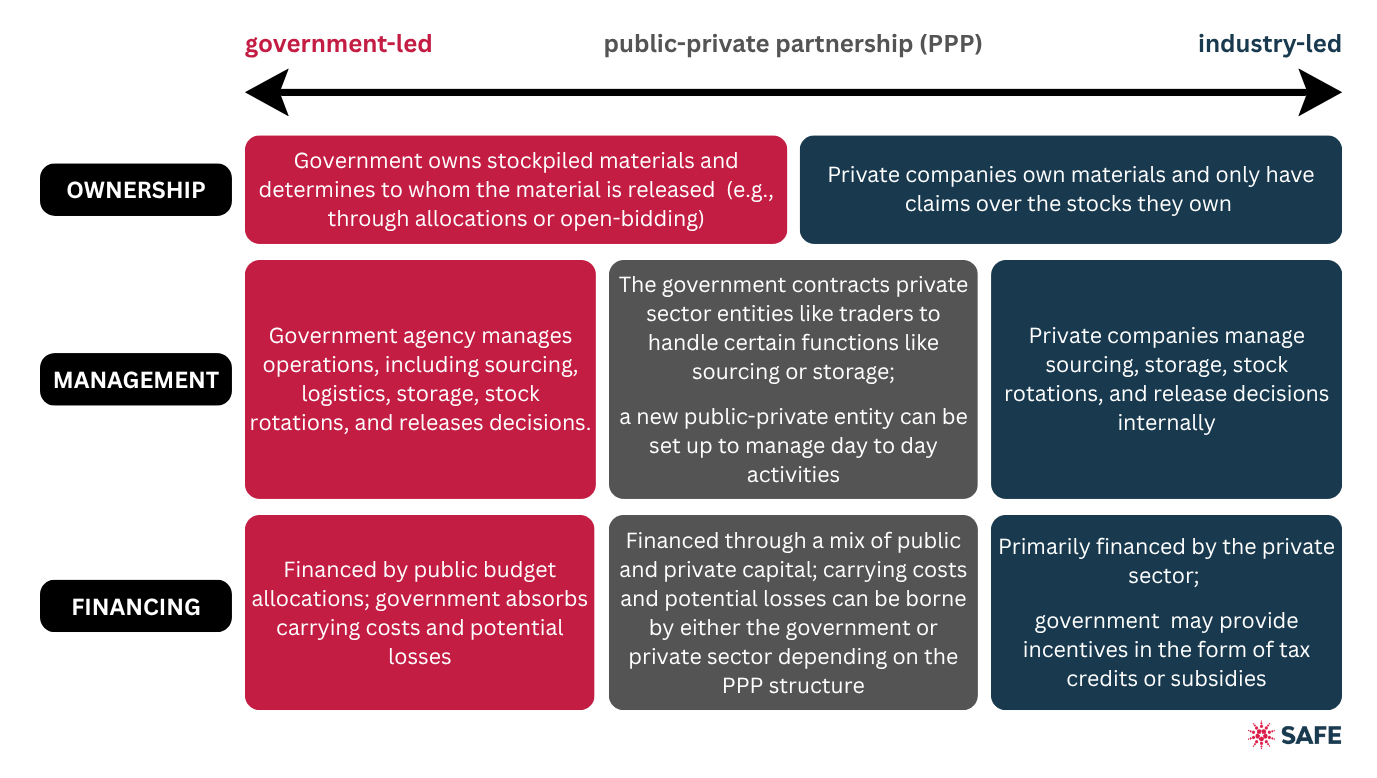
Stockpiling models can be understood along three dimensions: ownership, management, and financing. At one end of the spectrum are government-led stockpiles, where the public sector owns the material, finances its acquisition, and handles day-to-day operations. The government determines who can access the material and in what quantities. It can allocate material to certain priority users or release the material through an open-market bidding mechanism. The National Defense Stockpile is an example of a government-led stockpile.
Figure 1. Spectrum of Stockpiling Governance Models
In a government-led model, effective management of the stockpile requires close coordination with industry. Industry input can help the government identify the right materials, forms, specifications, and volumes to stockpile. It is also important to ensure government procurement does not unnecessarily compete with commercial buyers and that stockpile releases do not unintentionally contribute to oversupply or undermine producer economics.
At the other end of the spectrum are industry-led commercial stockpiles. Companies finance inventory acquisitions based on their needs and maintain full ownership of the material. This can be a more efficient approach because private entities have better information about the materials, specifications, and volumes they require. But it also runs counter to the lean manufacturing model that has shaped corporate inventory practices for decades. Large inventories incur storage and carrying costs while tying up working capital that could otherwise be deployed to improve near-term returns. The difficulty of justifying these costs is why industry-held stockpiles are typically established in response to government incentives or mandates rather than voluntarily.
Project Vault fits within this middle ground, designed to combine the strengths of both government- and industry-led models. Manufacturers play a central role in informing stockpiling priorities and ultimately retain ownership over the material they contract for. Traders bring an additional layer of commercial expertise, supporting material sourcing, transportation, logistics, and storage. Day-to-day management of the stockpile is handled by a private separate entity, Vault Co., which is structured to operate on a lean, cost-recovery basis. Export-Import Bank of the United States provides low-cost capital to cover the upfront cost of material acquisition, helping reduce financing costs and allowing manufacturers to participate in the Vault without tying up their working capital. (For more on this public-private partnership, see the 2026 SAFE Summit discussion Filling the Vault: Stockpiling and Mineral Security.)
This access to low-cost financing matters. According to the International Energy Agency’s analysis, Designing an Effective Strategic Stockpiling System for Critical Minerals, if a stockpile is managed primarily as a supply security tool, the upfront purchase cost of materials is often recovered during releases (materials are typically bought when supply is abundant and prices are lower, then released during shortages when prices are higher). The net cost of stockpiling is therefore determined by operating costs. Within the operating costs, financing is often the largest component, particularly for high-value, low-volume materials like gallium and germanium, while storage and warehousing costs become more significant for bulk, lower-value materials such as synthetic graphite and nickel sulphate.
Remaining Questions
What Market Signal Does Project Vault Provide to Critical Mineral Producers?
Project Vault is not designed as a traditional emergency stockpile where material remains untouched until a crisis. In addition to regular inventory rotation to account for shelf-life and inventory management requirements, participating manufacturers will be able to withdraw a portion of their contracted material during normal operations, subject to requirements to replenish those inventories. This means that the Vault can serve as a mechanism to manage critical mineral sourcing for interested participants.
Recent policy developments are also elevating Project Vault’s role as a sourcing mechanism. Executive Order 14415, which limits defense contractors’ ability to rely on waivers to manage sensitive-material sourcing restrictions, positions the Vault as a pathway for contractors to meet regulatory requirements.
It remains to be seen how downstream demand through Project Vault can translate into stronger market signals for suppliers and support new project development. Critical mineral producers often need long-term demand commitments early in project development to improve bankability and secure financing. Some critical mineral reserve proposals introduced in Congress envision the government acting as an interim buyer, bridging the timing gap between the early demand signals that suppliers need and future commercial demand.
The U.S. Commerce Department’s recent restrictions on exports of black mass and tungsten scrap illustrate where such a role could be useful. The federal government could step in as an interim buyer and stockpile material that domestic processors cannot yet absorb, preserving material until future capacity comes online.
Project Vault, however, is structured differently and would not fit this role: procurement will be driven by what participating manufacturers are prepared to contract for today, not by the government. Whether the demand from manufacturers can provide sufficient market signals to prospective suppliers remains an important question as the Vault model develops.
Price presents a separate question. It remains unclear whether participating manufacturers will be willing to pay a premium to source from more reliable suppliers partnered with the U.S. government, or whether procurement will need to remain competitive with Chinese benchmark prices.
Which Minerals Should be Targeted?
Project Vault is backed by a $10 billion EXIM loan and $2 billion investment from the private sector. This $12 billion funding outlay can go a long way in some critical mineral markets, and not very far in others. Bloomberg estimates that a hypothetical 60-day U.S. stockpile would cost roughly $5 billion for copper and $4.5 billion for aluminum—comparable to the cost of constructing new domestic processing facilities. SAFE analysis suggests that a new U.S. aluminum smelter could meet roughly 15% of projected U.S. primary aluminum demand by 2030.
At a similar aggregate cost, investing in multiple smelters could secure a much larger and more durable share of future supply than a stockpile covering less than a year of demand. As Project Vault takes flight, the tradeoffs between stockpiling and investing in processing or refining facilities will need to be considered in tandem.
Figure 2. Comparison of Project Vault Funding Compared to 60-Day Stockpile Projections
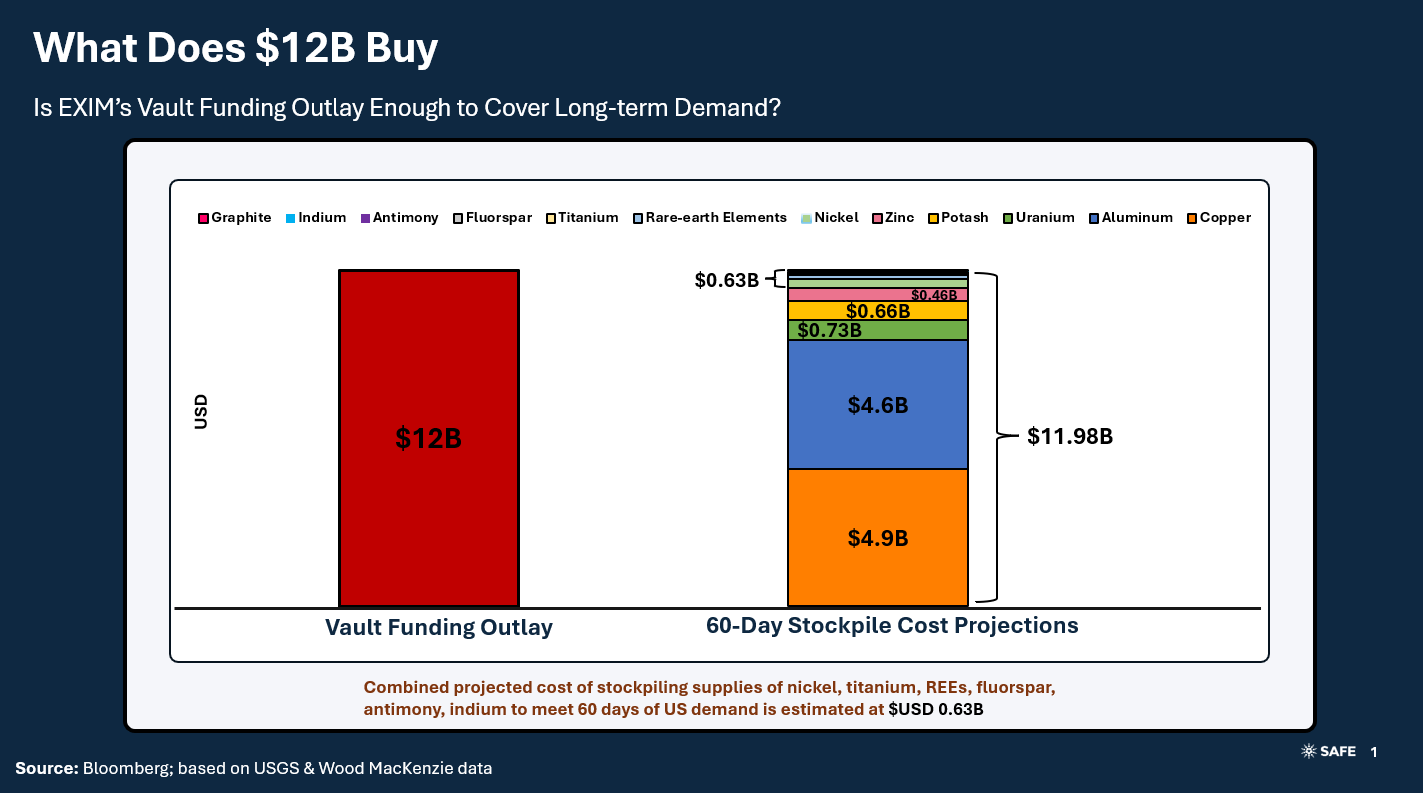
Vault’s current funding levels make it best-equipped to create effective stockpiles of minerals with smaller markets such as rare earth elements, indium, and titanium. Determining which minerals with smaller markets to focus on will have to be weighed by relative strategic importance. New methodologies such as the U.S. Geological Survey’s estimates of GDP impacts may help U.S. policymakers as they weigh these questions.
Another factor to consider is whether the stockpiled material has a viable pathway through downstream processing and manufacturing to ultimately reach end users. Investments in refining, processing, and manufacturing capacity will be necessary to fill in those missing capabilities.
How Will Project Vault Coordinate with the National Defense Stockpile?
While Vault’s public-private model potentially grants it greater flexibility to respond to the needs of American industries, U.S. policymakers will need to coordinate acquisition and releases between Vault and the NDS. These lines could become increasingly blurred if defense contractors participate in Project Vault. Coordination will be important across both acquisitions—to avoid competition for the same materials—and releases. Project Vault’s procurement can also inform NDS planning to help identify gaps and avoid duplicative efforts.
What Guardrails Will be in Place to Prevent Speculation?
Without clear guardrails on procurement, firms could treat the Vault as a speculative tool to make money (contracting for stockpiling when prices are low, and withdrawing material when prices rise). Unlike other materials that have been subject to historic U.S. stockpiling efforts, the scope of critical minerals markets and fundamental differences in how different minerals are traded pose greater challenges to policymakers in this regard.
This raises practical design questions. Should participation be limited to materials and volumes that companies demonstrably use? How would that be verified? Could companies stockpile beyond their operational needs, or build inventories in materials outside their core business? Should firms be required to use the material they withdraw for their own operations, or could they resell it into the market?
Will Project Vault Crowd Out Offtake Agreements?
Critical mineral producers rely on binding offtake agreements to demonstrate bankability to lenders and enable project financing. This raises a central design question: is the Vault meant to replace these agreements? The answer will depend largely on how full inventory releases are structured, what parameters are set for routine inventory access, and how the Vault is positioned in the market. If it functions as a market maker through which large volume of material routinely flows, it risks weakening incentives for manufacturers to enter into long-term contracts outside the Vault.
If Project Vault takes on a more prominent role in critical mineral markets, could it enter into long-term offtake agreements with prospective producers, or incentivize the traders it contracts to do so?
Conclusion
How Project Vault addresses many of these outstanding design questions will become clearer as participants finalize their term sheets and the Vault becomes operational. The answers will also help define where Vault fits within the broader U.S. policy landscape, and how it can work alongside similar initiatives among G7+ partners. The second part of this series will examine how close allies are approaching stockpiling and strategic reserve design.



 Twitter